
My flash piece “On the Island,” originally published by Confrontation in Issue 112, is now available to read online at PhoneFiction. I hope you enjoy it!

My flash piece “On the Island,” originally published by Confrontation in Issue 112, is now available to read online at PhoneFiction. I hope you enjoy it!
Foreign language scholars often find that they become someone else in many ways when they are elsewhere, inhabiting another language, another culture. Becoming immersed in a different culture and language is similar to writing fiction in this way: you enter a world and become someone in it so as to understand its order, its logic, its rhythms.
I am about to enter my last month of time at home with Audrey before I return to teaching. So I’ve been soaking in my time at home with her this summer. We’ve spent a fair amount of time in the backyard, tending our marigolds in the garden, swinging in the backyard swing, looking at bugs and butterflies together, and running through the sprinkler together (for Audrey, the first times).
When she’s napping or otherwise occupied, I write.
Fill in your own blanks, but these two things in tandem (spending time with my daughter on the cusp of year two, and immersed in my new novel) has made for some serious beauty this summer.
Two pieces have appeared recently by fellow writer-mothers that led me to put these thoughts together about this summer before I return to full-time teaching. Last week, I read Caitlin O’Neil’s lovely and inspirational essay about writing as the ultimate staycation. And then, a few days ago, Mary Vensel White wrote this astute essay based on Susan Sontag’s claim “if you want to go beyond something that is simply good or promising to the real fulfillment and risk-taking of a big body of work, you have to stay home.”
I was surprised and delighted by these two pieces juxtaposed with one another, as they fill in the gaps in something that’s been crossing my mind of late, that writing fiction is the ultimate escapist activity. It consumes your mind in a way that nothing else does. Even when I’m actually traveling—plane, train, car, in this country or another—I’m still in my skin, my life, my memories, my own awareness. Fiction? If you’re doing it right, you’re not just somewhere else – you’re someone else, too, consumed with their day-to-day, their consciousness, their joys and worries.
But so, too, does being a mother. I’m constantly amazed by the way that I perceive the world now – all of Audrey’s first times. The way the world must look from her vantage point, in terms of her stature, age, and experience. She amazes me.
And so motherhood and writing together? My world is all the more kaleidoscopic, multidimensional. Sometimes I wonder if I will ever need wanderlust again.
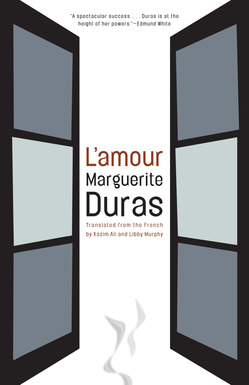
What first got me thinking about being somewhere else, someone else while writing was when I was drafting my introduction for an interview I conducted via email with Kazim Ali and Libby Murphy, the two translators of the first English edition of Marguerite Duras’ L’Amour, published this week by Open Letter Books. In my introduction I tried to convey to FWR readers—primarily fiction writers, of course—the experience of translating, and I compared it to inhabiting a character’s skin while that character was writing.
Truly great about the interview with Kazim and Libby was that, in addition to Duras’ mesmerizing text about former lovers’ return to the past, their responses to the interview questions also took me into another place. Here: the sleepy seaside resort town of Duras’ novel. There: the idyllic gardens and house in Oberlin, Ohio, where the translators did their work. Voici the poet, exalting a literary giant. Et voilà, the careful French scholar, attending to the movement between languages.
So I find the cover of Duras’ L’Amour (are those windows, or doors?) altogether fitting for the book and our interview, not to mention this period in my life. And I am so grateful for these many returns.
…here are some of my favorite novels featuring vivid scenes of winter:
The Borrower by Rebecca Makkai
The Lion, The Witch, and The Wardrobe by C.S. Lewis
Little House in the Big Woods by Laura Ingalls Wilder
My Antonia by Willa Cather
The Reception by Danielle Lavaque-Manty (not yet published, but will be soon!)
The Secret History by Donna Tartt
Straight Man by Richard Russo
You Are One of Them by Elliott Holt
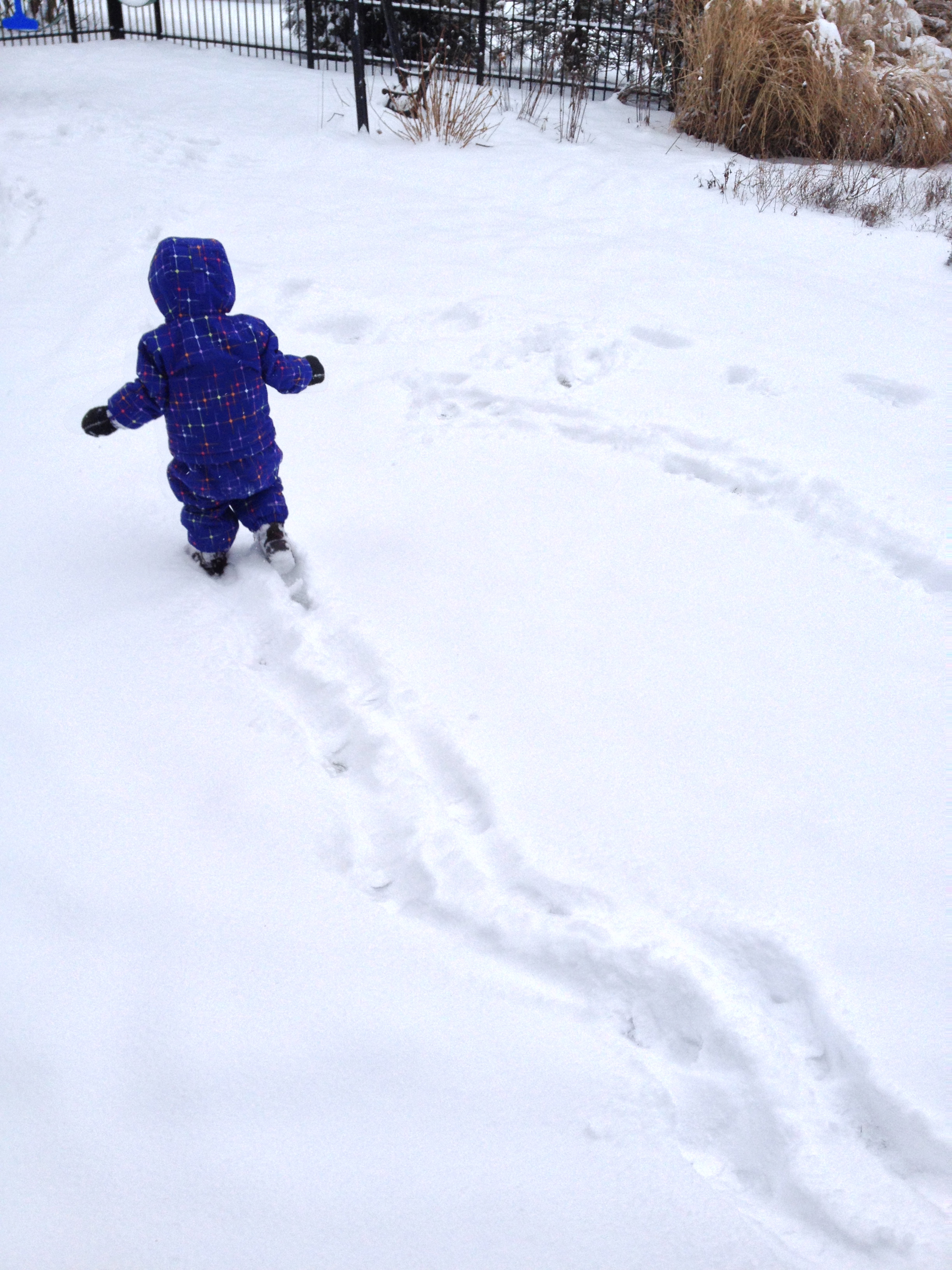
Audrey makes tracks, February 2013
Thanks to M. Lynx Qualey at Arabic Literature (in English), I woke up this morning to the announcement that Mazen Kerbaj’s new graphic novel is now available. Very much looking forward to getting my hands on this one – if I’m not mistaken (and someone please correct me if I am), it’s his first longer work in French.

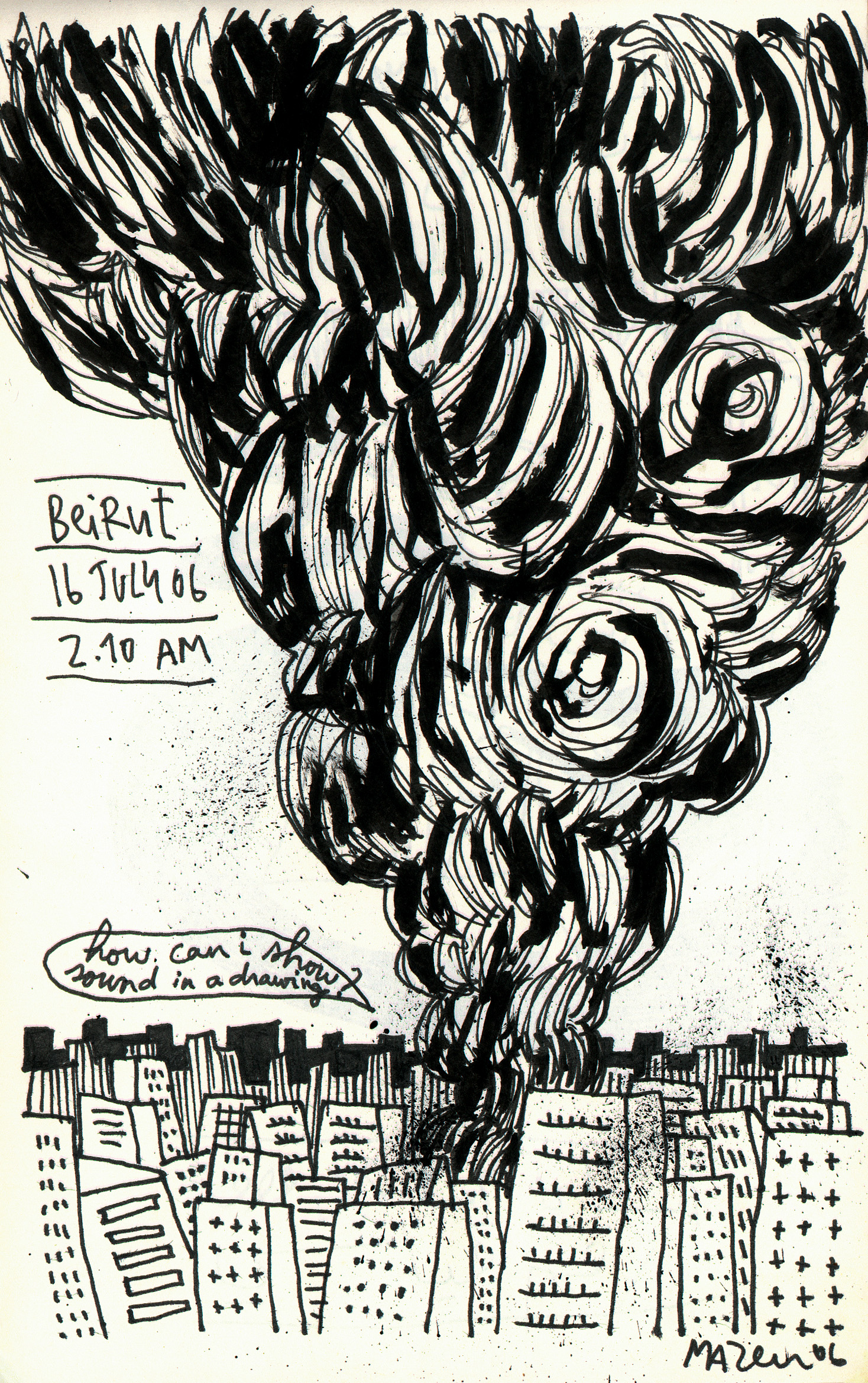
I first became aware of Mazen in 2007 through his blog account of the 2006 Israeli War in Lebanon (written primarily in English and some Arabic), which had been translated into French and published by L’Association. After I perused the book, I pulled up his blog, and found his minimalist improvised jazz piece, “Starry Night.” Here is how I described Mazen setting up to record this piece in my dissertation:
On the night of July 15-16, 2006, Lebanese avant jazz trumpeter and visual artist Mazen Kerbaj set up his recording equipment on the balcony of his Beirut apartment. Once the mics were set up and he had checked sound levels, he hit record. He then improvised on his trumpet to the sight and sounds of bombs falling from Israeli fighter jets. Over the thirty-three days of the 2006 Israeli War, Kerbaj recorded over nine hours of improvisation with the bombs.[1] On July 16, 2006, however, an unedited excerpt from these improvisations of Kerbaj’s first night on the balcony appeared in the sidebar of his blog. Entitled “Starry Night,” this minimalistic improvised piece has remained available on the blog sidebar ever since.
“Starry Night” was one of Kerbaj’s first responses to the Israeli War. The image that Kerbaj posted on his blog the day he posted the piece speaks, perhaps, to one of his aims for the musical piece: finding no clear and urgent means of expression through the visual, he turned to the musical.
[1] Email correspondence with Kerbaj, 28 May 2007.
Please enjoy my interview with the translators of the first English edition of Marguerite Duras’ L’Amour, newly published by Open Letter Books. I’ll reflect more on this interview and the book later this week.
 JP Solheim